Saturn:
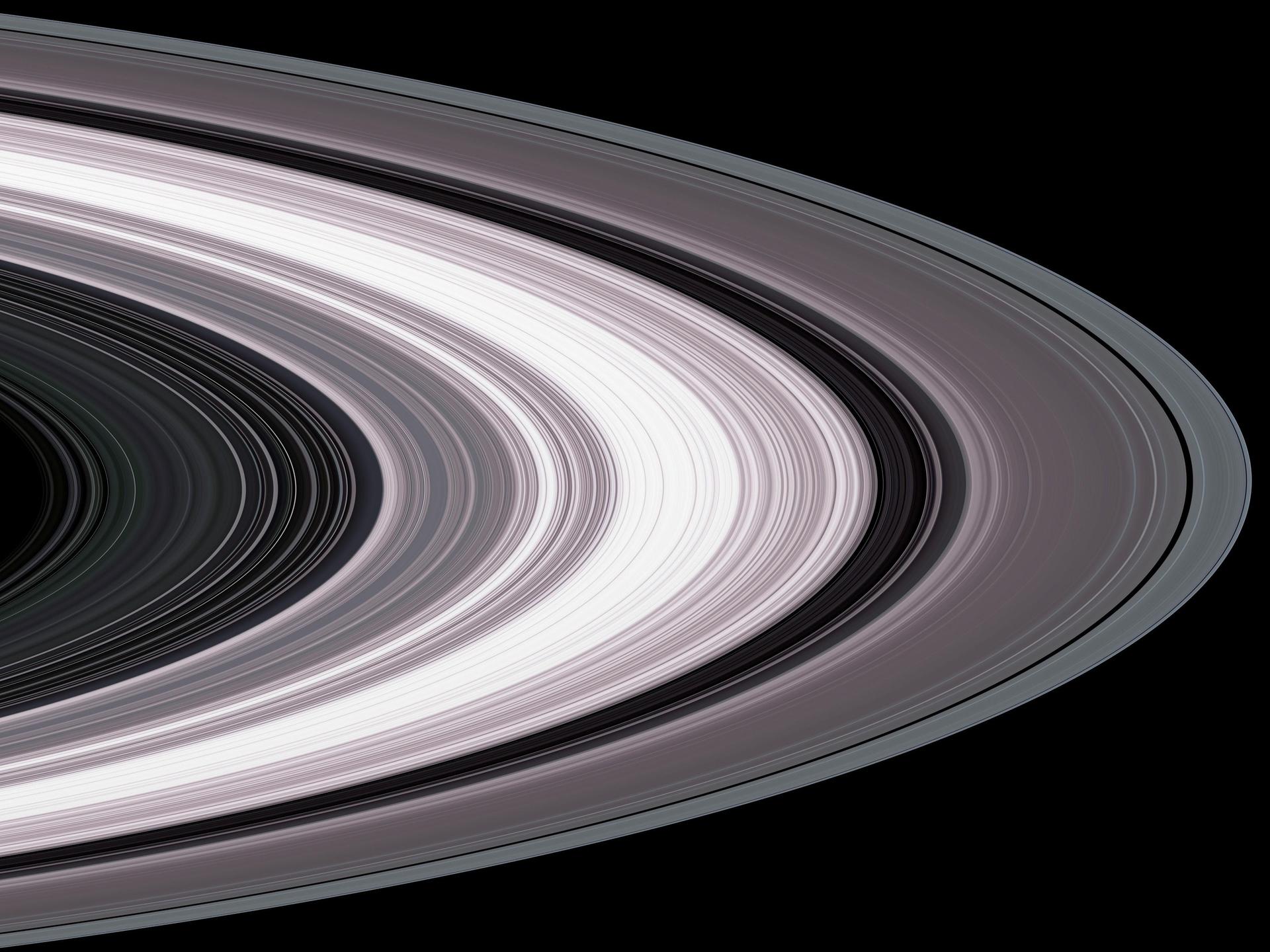
Saturn was the most distant of the five planets known to the ancients. In 1610, Italian astronomer Galileo Galilei was the first to gaze at Saturn through a telescope. To his surprise, he saw a pair of objects on either side of the planet. He sketched them as separate spheres, thinking that Saturn was triple-bodied. Continuing his observations over the next few years, Galileo drew the lateral bodies as arms or handles attached to Saturn. In 1659, Dutch astronomer Christiaan Huygens, using a more powerful telescope than Galileo's, proposed that Saturn was surrounded by a thin, flat ring. In 1675, Italian-born astronomer Jean-Dominique Cassini discovered a division between what are now called the A and B rings. It is now known that the gravitational influence of Saturn's moon
Mimas is responsible for the Cassini Division, which is 4,800 kilometers (3,000 miles) wide.
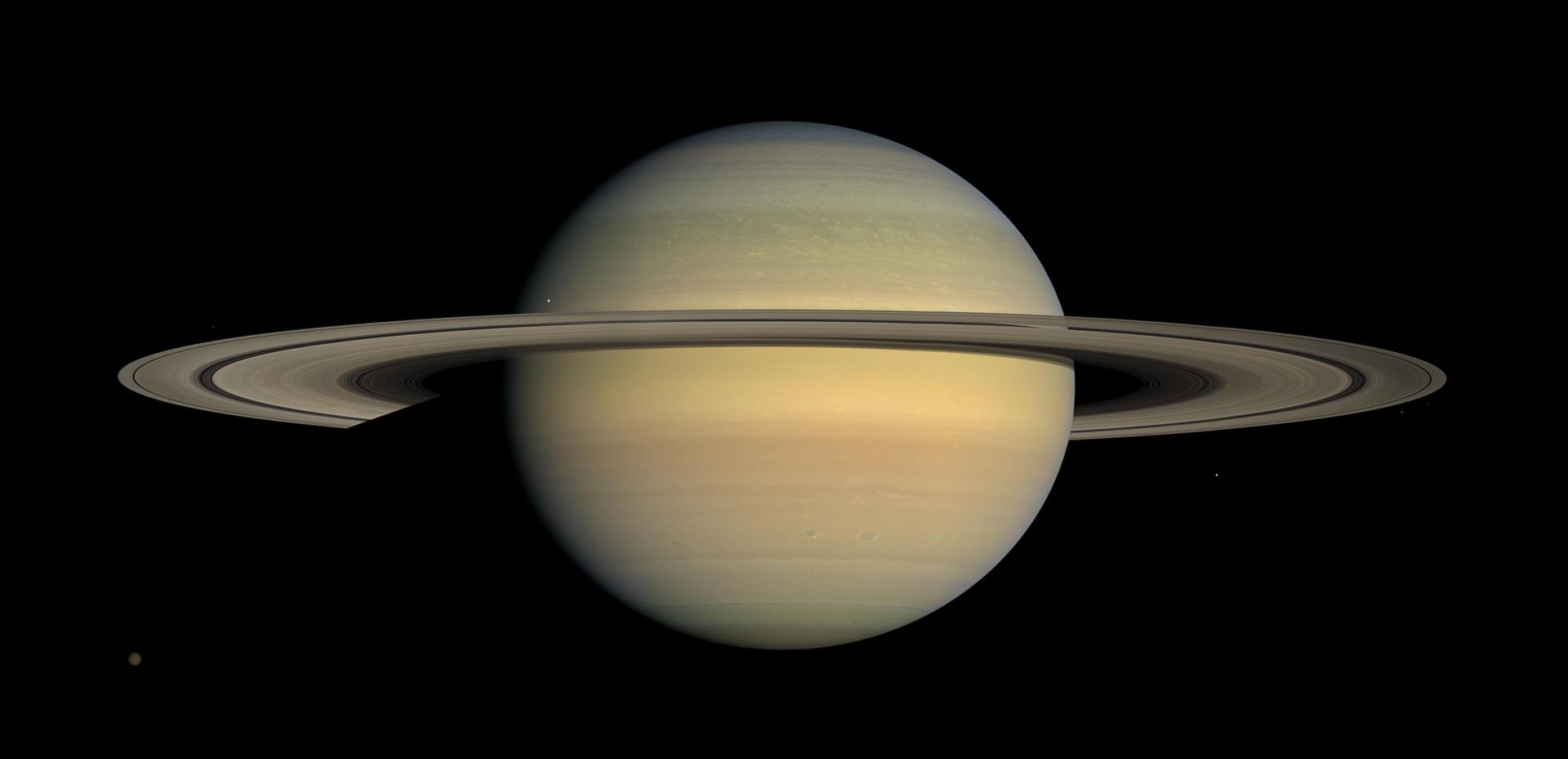
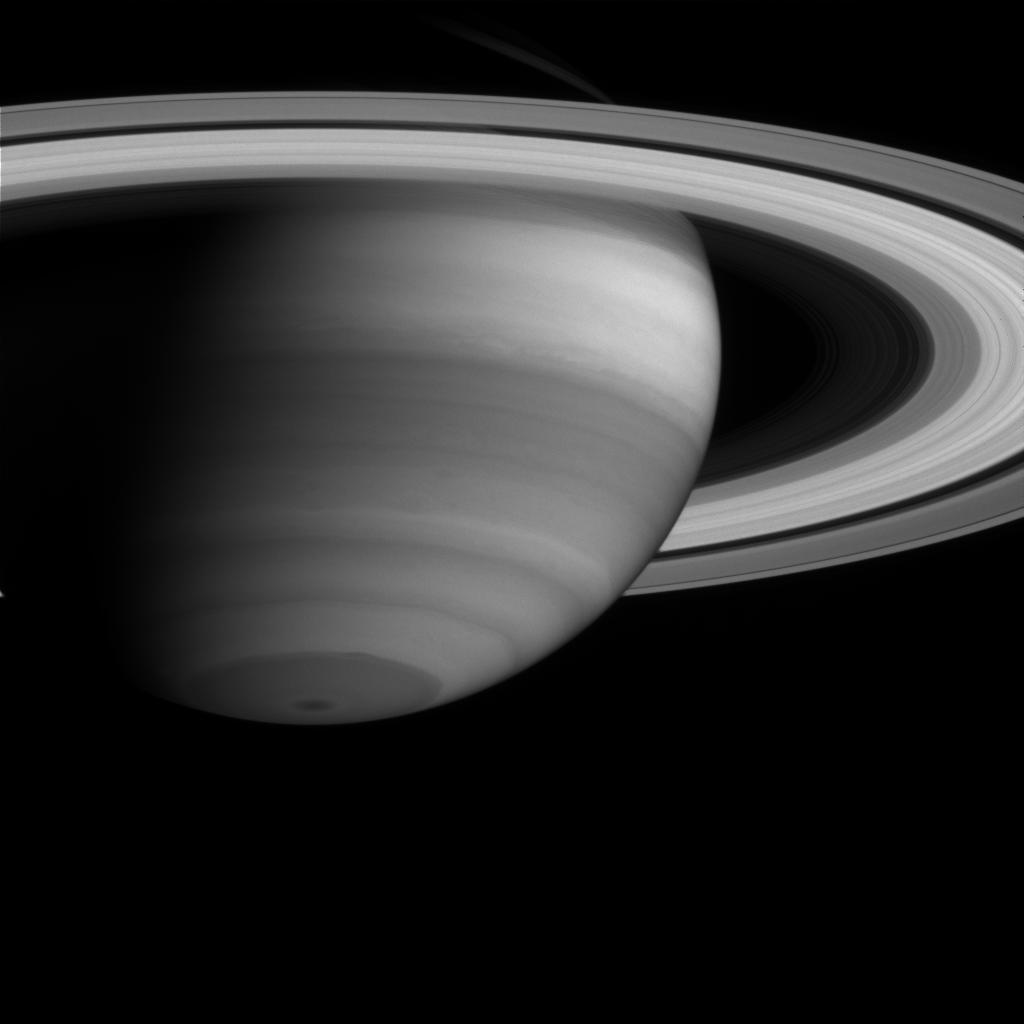
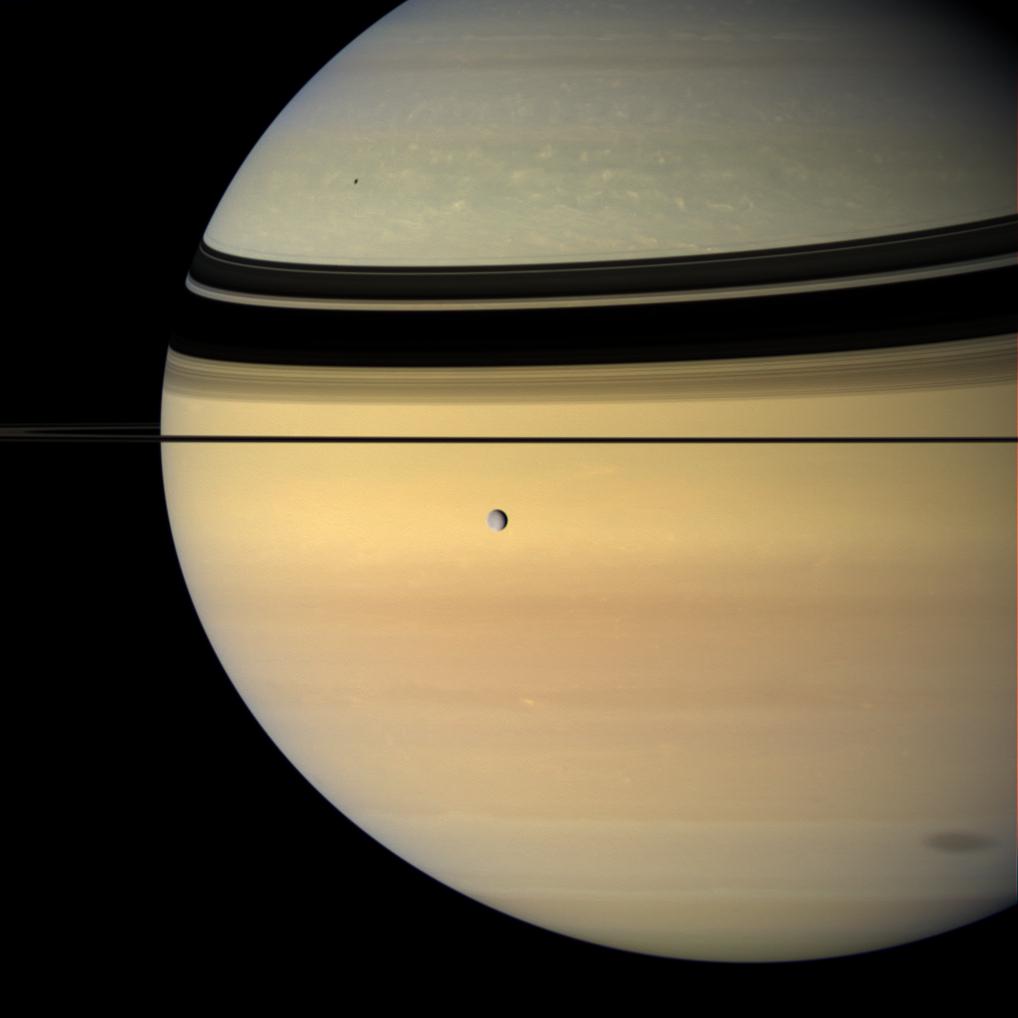
Like Jupiter, Saturn is made mostly of hydrogen and helium. Its volume is 755 times greater than that of Earth. Winds in the upper atmosphere reach 500 meters (1,600 feet) per second in the equatorial region. (In contrast, the strongest hurricane-force winds on Earth top out at about 110 meters, or 360 feet per second.) These super-fast winds, combined with heat rising from within the planet's interior, cause the yellow and gold bands visible in the atmosphere.
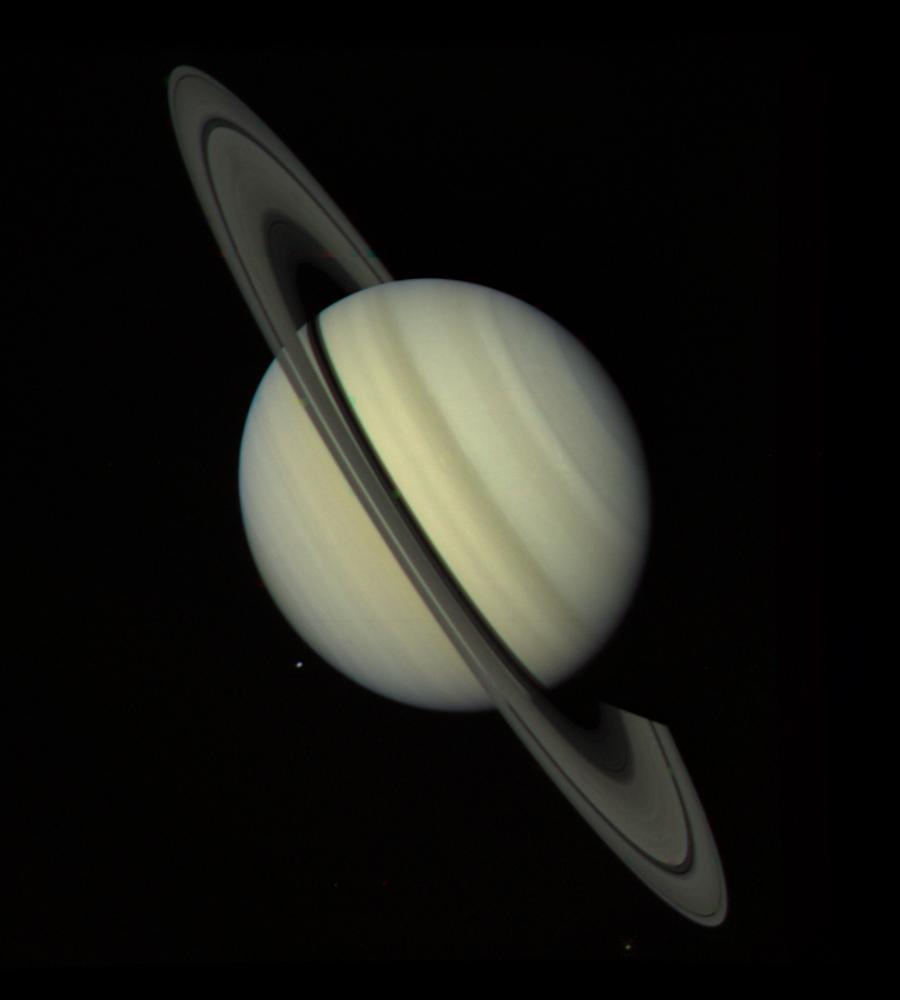
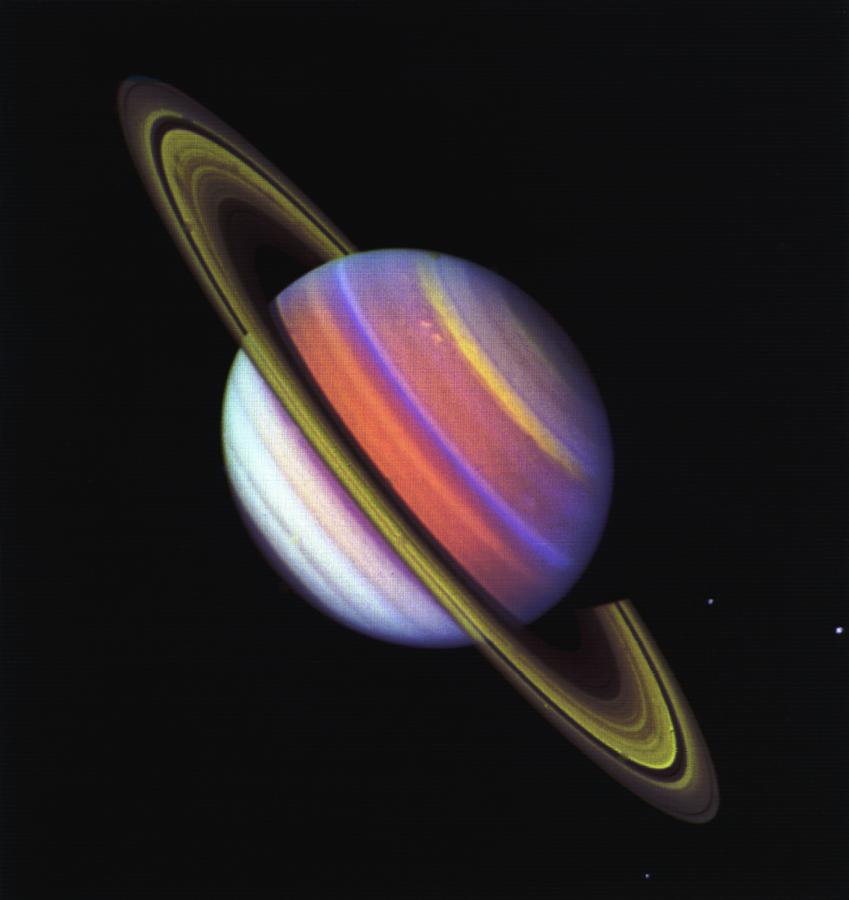
In the early 1980s, NASA's
Voyager 1 and
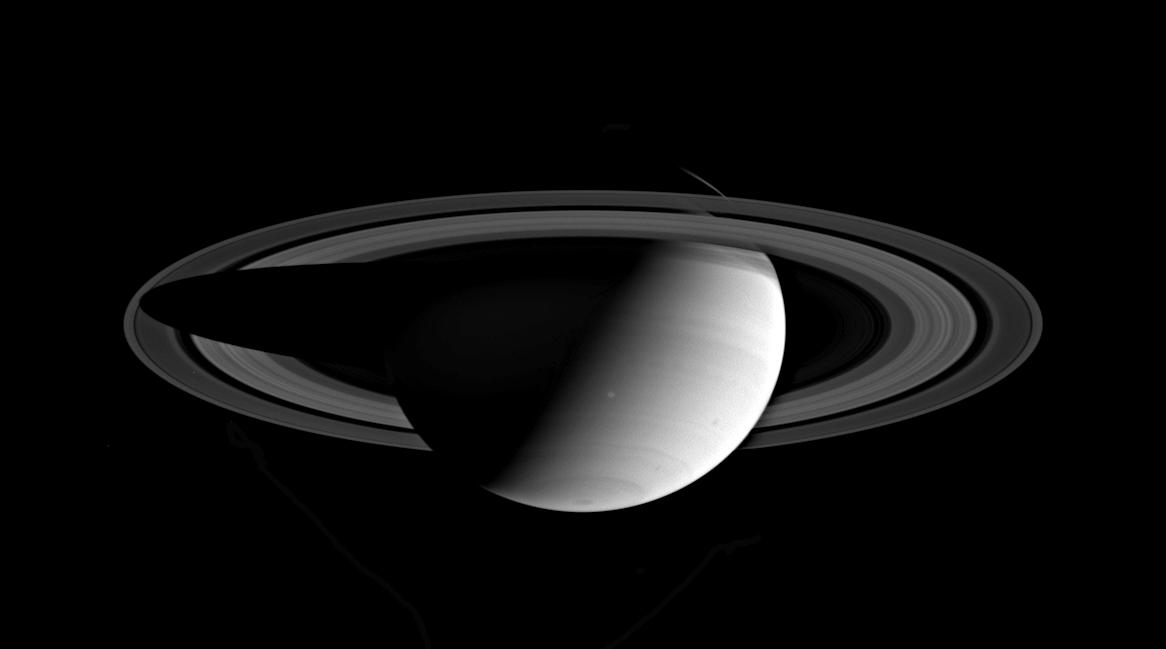
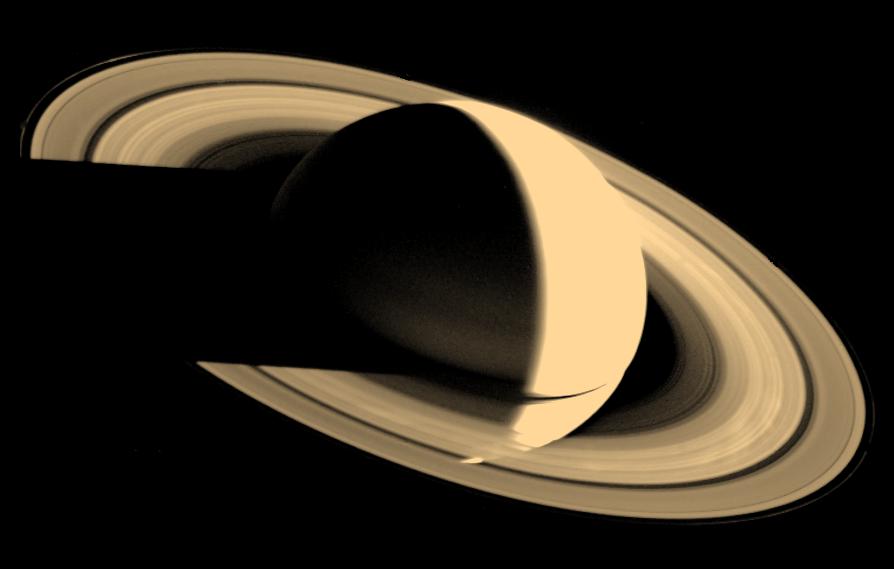
Voyager 2 spacecraft revealed that Saturn's rings are made mostly of water ice, and they imaged "braided" rings, ringlets, and "spokes" - dark features in the rings that circle the planet at different rates from that of the surrounding ring material. Saturn's ring system extends hundreds of thousands of kilometers from the planet, yet the vertical depth is typically about 10 meters (30 feet) in the main rings. During Saturn's equinox in autumn 2009, when sunlight illuminated the rings edge-on, Cassini spacecraft images showed vertical formations in some of the rings; the particles seem to pile up in bumps or ridges more than 3 kilometers (2 miles) tall.
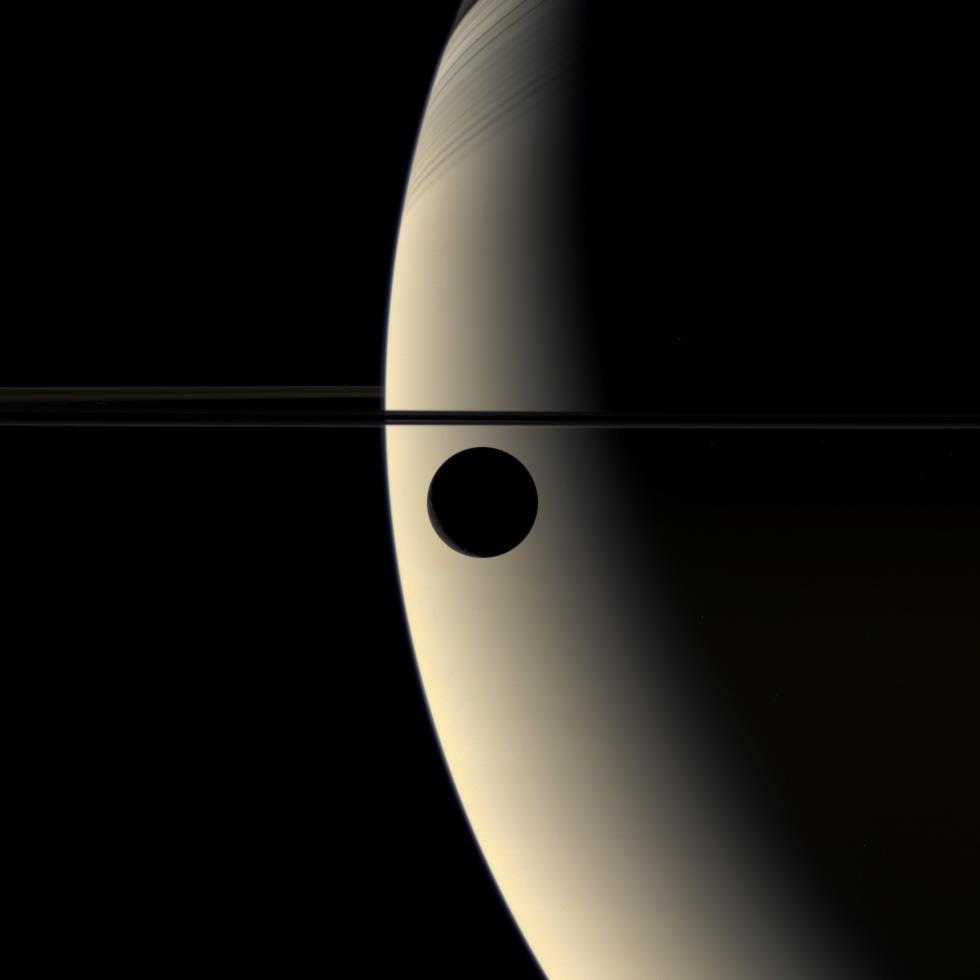
Saturn's largest moon, Titan, is a bit bigger than the planet Mercury. (Titan is the second-largest moon in the solar system; only Jupiter's moon Ganymede is bigger.) Titan is shrouded in a thick, nitrogen-rich atmosphere that might be similar to what Earth's was like long ago. Further study of this moon promises to reveal much about planetary formation and, perhaps, about the early days of Earth. Saturn also has many smaller icy satellites. From Enceladus, which shows evidence of recent (and ongoing) surface changes, to Iapetus, with one hemisphere darker than asphalt and the other as bright as snow, each of Saturn's satellites is unique.
Though Saturn's magnetic field is not as huge as Jupiter's, it is still 578 times as powerful as Earth's. Saturn, the rings, and many of the satellites lie totally within Saturn's enormous mag-netosphere, the region of space in which the behavior of electrically charged particles is influenced more by Saturn's magnetic field than by the solar wind. While the Hubble Space Telescope imaged Saturn's aurora in the ultraviolet, the Cassini spacecraft found that Saturn has a unique secondary aurora at the north pole, imaged in the infrared by in 2008. Aurorae occur when charged particles spiral into a planet's atmosphere along magnetic field lines. On Earth, these charged particles come from the solar wind. Cassini showed that at least some of Saturn's aurorae are like Jupiter's and are largely unaffected by the solar wind.
The next chapter in our knowledge of Saturn is being written right now by the Cassini mission, which carried Europe's Huygens probe to Saturn. The Huygens probe descended through Titan's atmosphere in January 2005, collecting data on the atmosphere and surface. The Cassini spacecraft, orbiting Saturn since 2004, continues to explore the planet and its moons, rings, and magnetosphere. By July 2009, Cassini had returned more than 200,000 images. The Cassini Equinox Mission is studying the rings during Saturn's autumnal equinox, when the Sun shines directly on the equator and three-dimensional features such as moonlets that protrude above and below the ring plane cast shadows, revealing their sizes and shapes.
How Saturn Got its Name
Saturn is named for the Roman god of agriculture.
Significant Dates
- 1610: Galileo Galilei reports seeing odd appendages on either side of Saturn; he did not realize he was viewing Saturn's rings.
- 1979: Pioneer 11 is the first spacecraft to reach Saturn, flying within 22,000 kilometers (13,700 miles) of the cloud tops.
- 1981: Using Saturn's powerful gravity as an interplanetary slingshot, Voyager 2 is placed on a path toward Uranus, then Neptune, then out of the solar system.
- 1994: The Hubble Space Telescope finds evidence of surface features beneath the hazy atmosphere of Saturn's largest moon, Titan.
- 2004: After a seven-year journey, Cassini becomes the first spacecraft to orbit Saturn.
- 2005: The Huygens probe successfully lands on Titan, return?ing images of the complex surface.
- 2005-2008: The Cassini spacecraft continues to return high-resolution images of the Saturn system. Mission discoveries include evidence for liquid hydrocarbon lakes of methane and ethane on Titan, a new radiation belt around Saturn, new rings and moons, and icy jets and geysers at the south polar region of the moon Enceladus.
- 2008: Cassini's four-year mission is extended for two years and designated the Cassini Equinox Mission.