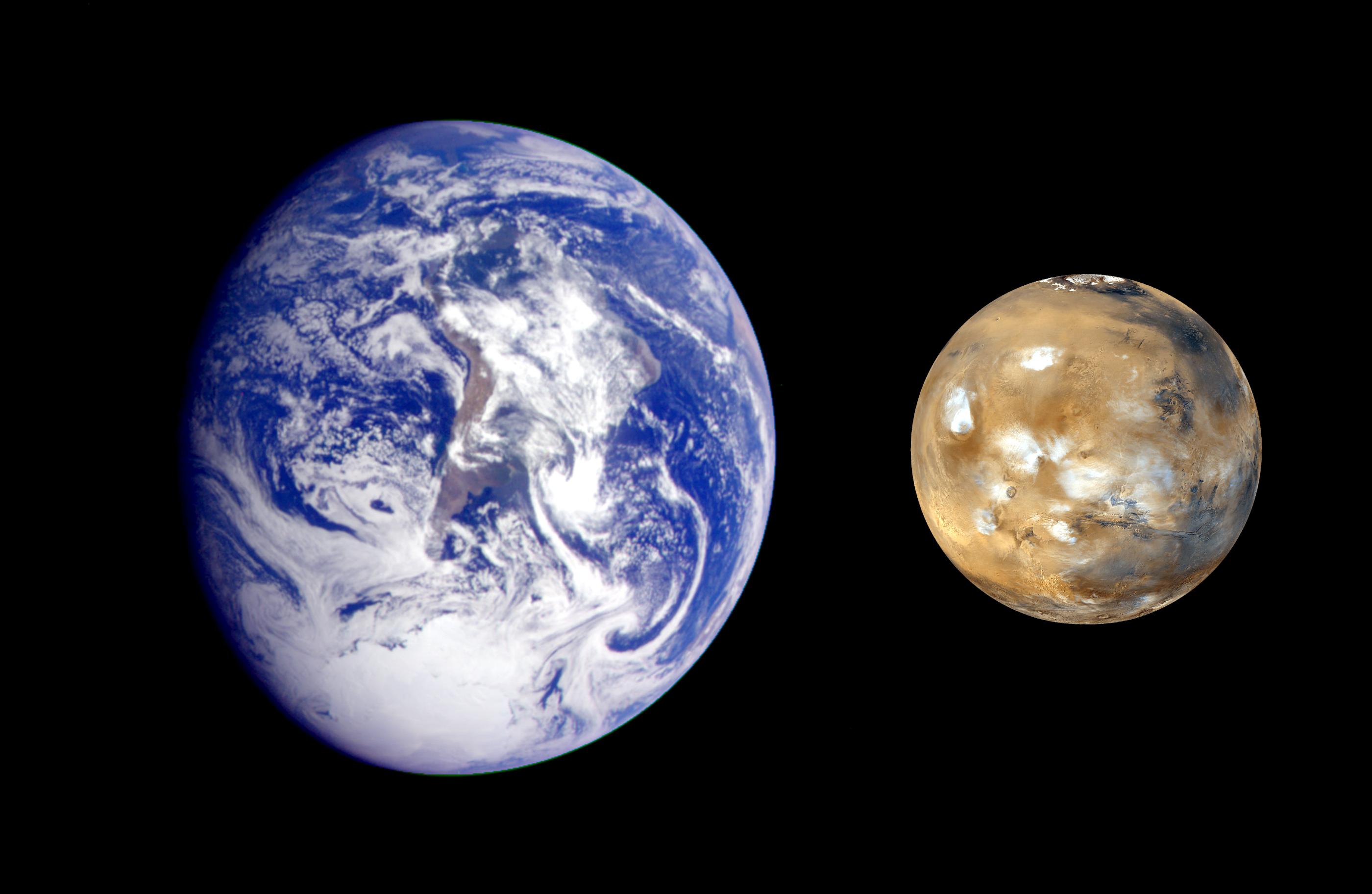
Mars Activities
The lessons below are teacher-favorite lessons focused on the Red Planet. For more search options or to search by other science target, missions and other criteria, visit our Fast Lesson Finder. You can also search by curriculum standards on our popular Curriculum Standards Quilts.
Mars Lessons:
Alka-Seltzer Rockets
Topic: Modeling Solar System Objects
Grade Level: 5-8
Body: Sun, Mercury, Venus, Earth, Mars, Asteroids, Jupiter, Saturn, Uranus, Neptune, Comets, Kuiper Belt & Oort Cloud, Earth's Moon
Short Description: Using baking soda and vinegar, propel an object across the floor to introduce the idea of how things move through space.
Analyzing Elemental Abundances
Grade Level: 9-12
Body: Sun, Mercury, Venus, Earth, Mars, Asteroids, Jupiter, Saturn, Uranus, Neptune, Comets, Kuiper Belt & Oort Cloud
Mission: Genesis (Our Solar System)
Short Description: Participants will practice and understand the use of ratios in describing the abundances of isotopes.
Boiling Water Below Its Boiling Point
Grade Level: 9-12
Body: Mars
Mission: Mars Recon Orbiter (Mars)
Short Description: Participants discuss the relationship between pressure and boiling point as they discover that water boils when its vapor pressure equals atmospheric pressure.
Changing Theories About Mars
Grade Level: 5-8
Body: Mars
Short Description: Once thought to be home to life forms that built canals, the view of Mars' habitability has changed significantly over the past several decades. Keeping open-minded about new information allows scientists to fully explore options. Open-mindedness is important to the culture of science. Click here to access the resource for this activity.
Changing Theories About Mars (Activity Resource)
Grade Level: 5-8
Body: Mars
Short Description: The various ideas about Mars are mapped out in this handy timeline and chart comparing Mars and Earth.
Dirty Ice or Icy Dirt (Slides)
Topic: Modeling Solar System Objects
Grade Level: 5-8, 9-12
Body: Mars
Mission: Phoenix (Mars)
Short Description: Large amounts of water ice appear to be buried at high latitudes on Mars. In this activity, students make physical models using Earth samples to investigate whether it is more likely that these regions of Mars are composed of icy dirt (with ice filling the pore space of soils) or dirty ice (with dust sprinkled through a mostly icy surface).
Dirty Ice or Icy Dirt (Student Guide)
Topic: Modeling Solar System Objects
Grade Level: 5-8, 9-12
Body: Mars
Mission: Phoenix (Mars)
Short Description: Large amounts of water ice appear to be buried at high latitudes on Mars. In this activity, students make physical models using Earth samples to investigate whether it is more likely that these regions of Mars are composed of icy dirt (with ice filling the pore space of soils) or dirty ice (with dust sprinkled through a mostly icy surface).
Dirty Ice or Icy Dirt (Teacher Guide)
Topic: Modeling Solar System Objects
Grade Level: 5-8, 9-12
Body: Mars
Mission: Phoenix (Mars)
Short Description: Large amounts of water ice appear to be buried at high latitudes on Mars. In this activity, students make physical models using Earth samples to investigate whether it is more likely that these regions of Mars are composed of icy dirt (with ice filling the pore space of soils) or dirty ice (with dust sprinkled through a mostly icy surface).
Earth, Earth's Moon, Mars Balloons
Topic: Modeling Solar System Objects
Grade Level: K-4, 5-8
Body: Earth, Mars, Earth's Moon
Short Description: Curiosity about our place in space and whether we can travel to distant worlds beyond our own depends upon understanding the size, distance and other characteristics of moons and planets in our solar system. For this activity, students will construct a balloon scale model to understand the relative sizes of the Earth, Earth's Moon and Mars in relation to each other and their relative distance to each other at this scale. They will use this model to predict distances and reflect on how scientists use models to construct explanations through the scientific process. In this collection, this activity introduces the concept of models, which will be built upon in subsequent lessons, as well as the first set of Earth/Mars comparisons.
Geologic Landforms of Mars
Topic: Landforms
Grade Level: 5-8
Body: Mars
Mission: Mars Recon Orbiter (Mars)
Short Description: Participants use aerial photos of the Martian surface to study landforms of Mars and interpret the geologic processes which formed them.