Calypso

Calypso was discovered by D. Pascu, P.K. Seidelmann, W. Baum, and D. Currie in March 1980 using a ground-based telescope.
Calypso is a Trojan (trailing moon) of the larger moon Tethys, orbiting 183,000 miles (295,000 km) from Saturn, completing one orbit in 45 hours. Calypso follows Tethys in its orbit by 60 degrees. (Telesto is the other Tethys Trojan, orbiting Saturn 60 degrees ahead of Tethys.) Together, Calypso and Telesto are known as the "Tethys Trojans" and were discovered in the same year.
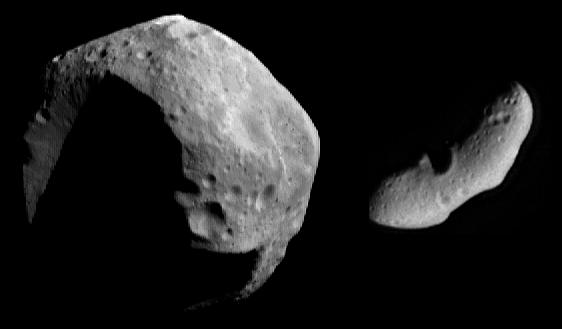
Calypso has a mean radius of 6.6 miles (10.7 km) across. Like many other small Saturnian moons and small asteroids, Calypso is irregularly shaped by overlapping large craters. This moon appears to also have loose surface material capable of smoothing the appearance of craters. Its surface is one of the most reflective (at visual wavelengths) in the solar system, with a visual geometric albedo (a measure of how reflective the surface is) of 1.34. This very high reflectiveness could be the result of particles from Saturn's E-ring, which is composed of small ice particles generated by Enceladus' south polar geysers.
Moons of Saturn were originally named for Greco-Roman Titans and descendants of the Titans. But as many new moons were discovered, scientists began selecting names from more mythologies, including Gallic, Inuit, and Norse stories.
Originally called S/1980 S25, Calypso is named for a nymph whose name means "I hide." A daughter of the Titans, Oceanus and Tethys, she lived alone on her island until she fell in love with the explorer Odysseus (called Ulysses by the Romans; his name means "one who suffers"). Calypso helped Odysseus find his way home after his long voyage and dangerous adventures.