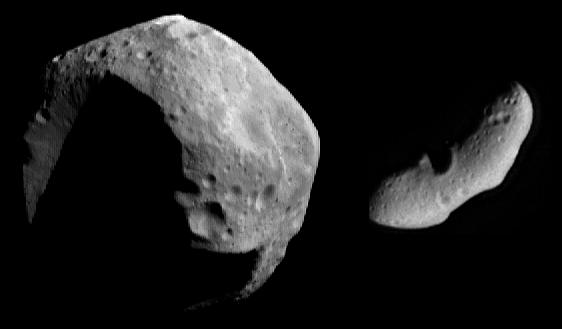
Asteroids:
Asteroids, sometimes called minor planets, are small, rocky fragments left over from the formation of our solar system about 4.6 billion years ago. Most of this ancient space rubble can be found orbiting the Sun between Mars and Jupiter. Asteroids range in size from Ceres, about 952 kilometers (592 miles) in diameter, to bodies that are less than 1 kilometer (0.6 mile) across. The total mass of all the asteroids is less than that of Earth's Moon.
Early in the history of the solar system, the formation of Jupiter brought an end to the formation of planetary bodies in the gap between Mars and Jupiter and caused the small bodies that occupied this region to collide with one another, fragmenting them into the asteroids we observe today. This region, called the asteroid belt or simply the main belt, may contain millions of asteroids. Because asteroids have remained mostly unchanged for billions of years, studies of them could tell us a great deal about the early solar system.
Nearly all asteroids are irregularly shaped, though a few are nearly spherical, and are often pitted or cratered. As they revolve around the
Sun in elliptical orbits, the asteroids also rotate, sometimes quite erratically, tumbling as they go. More than 150 asteroids are known to have a small companion moon (some have two moons). There are also binary (double) asteroids, in which two rocky bodies of roughly equal size orbit each other, as well as triple asteroid systems.
The three broad composition classes of asteroids are C-, S-, and M-types. The C-type asteroids are most common, probably consist of clay and silicate rocks and are dark in appearance. They are among the most ancient objects in our solar system. The S-types (stony) are made up of silicate materials and nickel-iron. M-types are metallic (nickel-iron). The asteroids' compositional differences are related to how far from the Sun they formed. Some experienced high temperatures after they formed and partly melted, with iron sinking to the center and forcing basaltic (volcanic) lava to the surface. One such asteroid, Vesta, survives to this day.
Jupiter's massive gravity and occasional close encounters with Mars or another object change the asteroids' orbits, knocking them out of the main belt and hurling them into space in both directions across the orbits of the planets. Stray asteroids and asteroid fragments slammed into Earth and the other planets in the past, playing a major role in altering the geological history of the planets and in the evolution of life on Earth. Scientists continuously monitor Earth-crossing asteroids, whose paths intersect Earth's orbit, including near-Earth asteroids that may pose an impact danger. Radar is a valuable tool in detecting and monitoring potential impact hazards. By bouncing transmitted signals off objects, images and information can be derived from the echoes. Scientists can learn a great deal about an asteroid's orbit, rotation, size, shape, and metal concentration. The U.S. is the only country that has an operating survey and detection program for discovering near-Earth objects.
 | |
NASA space missions have flown by and observed asteroids. The
Galileo spacecraft flew by asteroids Gaspra in 1991 and Ida in 1993; the
NEAR-Shoemaker mission studied asteroids Mathilde and Eros; and
Deep Space 1 and
Stardust both had close encounters with asteroids.
In 2005, the Japanese spacecraft Hayabusa landed on the near-Earth asteroid Itokawa and attempted to collect samples. When Hayabusa returns to Earth in June 2010, we will find out if it was successful.
NASA's Dawn mission, launched in September 2007 on a 3-billion-kilometer (1.7-billion-mile) journey to the asteroid belt, is planned to orbit the asteroids Vesta and Ceres. Vesta and Ceres are sometimes called baby planets - their growth was interrupted by the formation of Jupiter, and they followed different evolutionary paths. Scientists hope to characterize the conditions and processes of the solar system's earliest epoch by studying these two very different large asteroids.
How Asteroids Got Their Names
The International Astronomical Union's Committee on Small Body Nomenclature.is a little less strict when it comes to naming asteroids. So out there orbiting the Sun we have giant space rocks named for Mr. Spock (of Star Trek fame), rock musician Frank Zappa, regular guys like Phil Davis and more somber tributes such as the seven asteroids named for the crew of the Space Shuttle Columbia killed in 2003. Asteroids are also named for places and a variety of other things. Pet named are not allowed.
Asteroids are also given a number, for example 99942 Apophis. The Harvard Smithsonian Center for Astrophysics keeps a fairly curent list of asteroid names.
Significant Dates
- 1801: Giuseppe Piazzi discovers the first and largest asteroid, Ceres, orbiting between Mars and Jupiter.
- 1898: Gustav Witt discovers Eros, one of the largest near-Earth asteroids.
- 1991-1994: The Galileo spacecraft takes the first close-up images of an asteroid (Gaspra) and discovers the first moon (later named Dactyl) orbiting an asteroid (Ida).
- 1997-2000 : The NEAR Shoemaker spacecraft flies by Mathilde and orbits and lands on Eros.
- 1998: NASA establishes the Near-Earth Program Office to detect, track, and characterize potentially hazardous asteroids and comets that could approach Earth.
- 2006: Ceres attains a new classification -- dwarf planet -- but retains its distinction as the largest known asteroid.
- 2007: The Dawn spacecraft is launched on its journey to the asteroid belt to study Vesta and Ceres.
- 2008: The European spacecraft Rosetta, on its way to study a comet in 2014, flies by and photographs asteroid Steins, a type of asteroid composed of silicates and basalts.