|
|
|
About the Sun
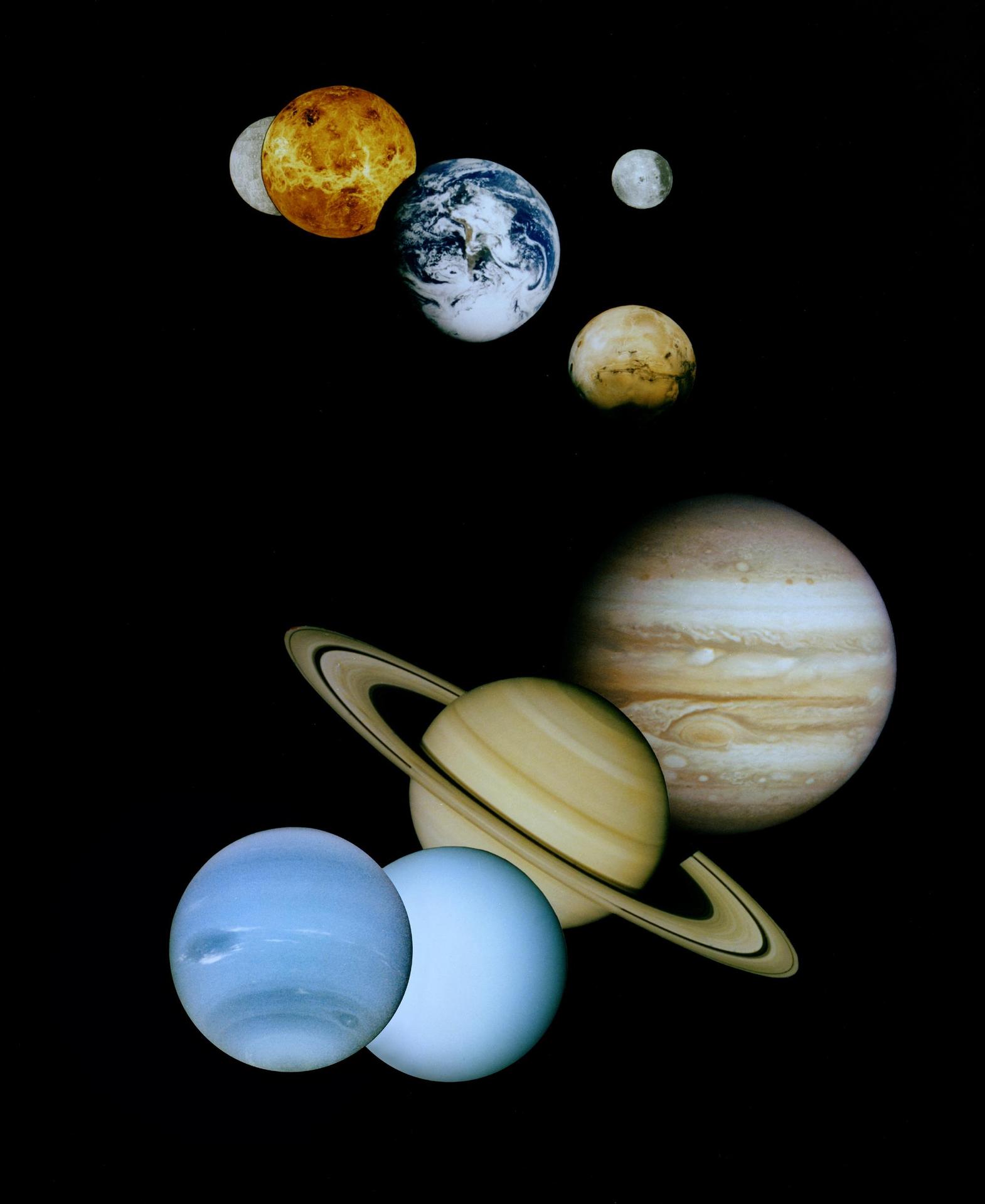
The sun is a star, a hot ball of glowing gases at the heart of our solar system. Its influence extends far beyond the orbits of distant Neptune and Pluto. Without the sun's intense energy and heat, there would be no life on Earth. And though it is special to us, there are billions of stars like our sun scattered across the Milky Way galaxy.
More
About
SDO studies the sun's influence by observing the solar atmosphere simultaneously in several wavelengths. The orbiting observatory will help determine if it is possible to make reliable space weather forecasts.
More
This ultraviolet image of our sun shows bright, glowing arcs of gas flowing around sunspots.
About Mercury
Sun-scorched Mercury is only slightly larger than Earth's Moon. Like the Moon, Mercury has very little atmosphere to stop impacts, and it is covered with craters. Mercury's dayside is super-heated by the sun, but at night temperatures drop hundreds of degrees below freezing. Ice may even exist in craters. Mercury's egg-shaped orbit takes it around the sun every 88 days.
More
About MESSENGER
NASA's MESSENGER is the first spacecraft to orbit Mercury. The spacecraft made three flybys before settling into its primary orbital science mission in March 2011.
More
The sprawling Caloris basin on Mercury is one of the solar system's largest impact basins.
About Venus
Venus is a dim world of intense heat and volcanic activity. Similar in structure and size to Earth, Venus' thick, toxic atmosphere traps heat in a runaway 'greenhouse effect.' The scorched world has temperatures hot enough to melt lead. Glimpses below the clouds reveal volcanoes and deformed mountains. Venus spins slowly in the opposite direction of most planets.
More
About Pioneer Venus 1
Pioneer Venus 1 found Venus to be generally smoother than Earth, though with a mountain higher than Mt. Everest and a chasm deeper than the Grand Canyon.
More
Scientists used radar to map surface details hidden by Venus' permanent cloud layers.
About Earth
Earth is an ocean planet. Our home world's abundance of water -- and life -- makes it unique in our solar system. Other planets, plus a few moons, have ice, atmospheres, seasons and even weather, but only on Earth does the whole complicated mix come together in a way that encourages life -- and lots of it.
More
Earth Science Missions
Orbiting spacecraft study our home world from above as a whole system and aid in our understanding how the planet is changing.
More
Earth and its Moon are nicely framed in this image taken from the Space Shuttle Discovery.
About Mars
Mars is a cold desert world. It is half the diameter of Earth and has the same amount of dry land. Like Earth, Mars has seasons, polar ice caps, volcanoes, canyons and weather, but its atmosphere is too thin for liquid water to exist for long on the surface. There are signs of ancient floods on Mars, but evidence for water now exists mainly in icy soil and thin clouds.
More
Curiosity
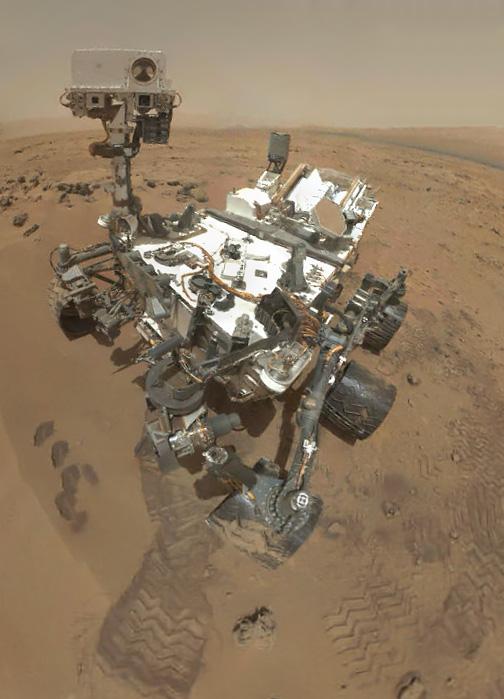
Curiosity, a robotic rover about the size of a small SUV, is designed to find whether the Red Planet ever was -- or is still today -- an environment suitable for life.
More
Viking proved spacecraft could survive for long periods on Mars -- paving the way for today's rovers
About Jupiter
The most massive planet in our solar system -- with dozens of moons and an enormous magnetic field -- Jupiter forms a kind of miniature solar system. It resembles a star in composition, but did not grow big enough to ignite. The planet's swirling cloud stripes are punctuated by massive storms such as the Great Red Spot, which has raged for hundreds of years.
More
Juno
NASA's Juno polar orbiter will study how Jupiter formed and became the dynamic world we see today. Juno will help us better understand the formation of our solar system and other planetary systems.
More
Humans have watched this giant, raging storm on Jupiter -- the Great Red Spot -- since the 1800s.
About Saturn
Adorned with thousands of beautiful ringlets, Saturn is unique among the planets. All four gas giant planets have rings -- made of chunks of ice and rock -- but none are as spectacular or as complicated as Saturn's. Like the other gas giants, Saturn is mostly a massive ball of hydrogen and helium.
More
Cassini
NASA's Cassini orbiter is on an extended mission to explore Saturn and its rings, magnetosphere and moons. Cassini also delivered Europe's Huygens probe to its historic landing on Titan in 2005.
More
Few sights are more strikingly beautiful than Saturn embraced by the shadows of its stately rings.
About Uranus
Uranus is the only giant planet whose equator is nearly at right angles to its orbit. A collision with an Earth-sized object may explain the unique tilt. Nearly a twin in size to Neptune, Uranus has more methane in its mainly hydrogen and helium atmosphere than Jupiter or Saturn. Methane gives Uranus its blue tint.
More
About Voyager 2
Most of what we know about Uranus came from Voyager 2's flyby in 1986. The spacecraft discovered 10 additional moons and several rings before heading on to Neptune.
More
Hubble's near-infrared images show clouds and rings not visible to the unaided eye.
About Neptune
Dark, cold and whipped by supersonic winds, Neptune is the last of the hydrogen and helium gas giants in our solar system. More than 30 times as far from the sun as Earth, the planet takes almost 165 Earth years to orbit our sun. In 2011 Neptune completed its first orbit since its discovery in 1846.
More
Voyager 2
Most of what we know about Neptune is thanks to Voyager 2's 1989 flyby. The spacecraft discovered six of Neptune's moons.
More
Voyager 2 captured this stunning view of Neptune and its large moon Triton in 1989.
About Pluto
Discovered in 1930, Pluto was long considered our solar system's ninth planet. But after the discovery of similar intriguing worlds deeper in the distant Kuiper Belt, icy Pluto was reclassified as a dwarf planet. This new class of worlds may harbor some of the best evidence about the origins our solar system.
More
About New Horizons
NASA's New Horizons will be the first spacecraft to visit Pluto and the Kuiper Belt. The spacecraft's long journey began in January 2006. It will not reach Pluto until 2015.
More
Kuiper Belt Objects -- such as Pluto and its moons -- are too small and distant for detailed images.
News & Events:
NASA Administrator Visits JPL, Talks Asteroids
Today, NASA Administrator Charles Bolden met with members of the asteroid initiative team at NASA's Jet Propulsion Laboratory. More 
News & Events:
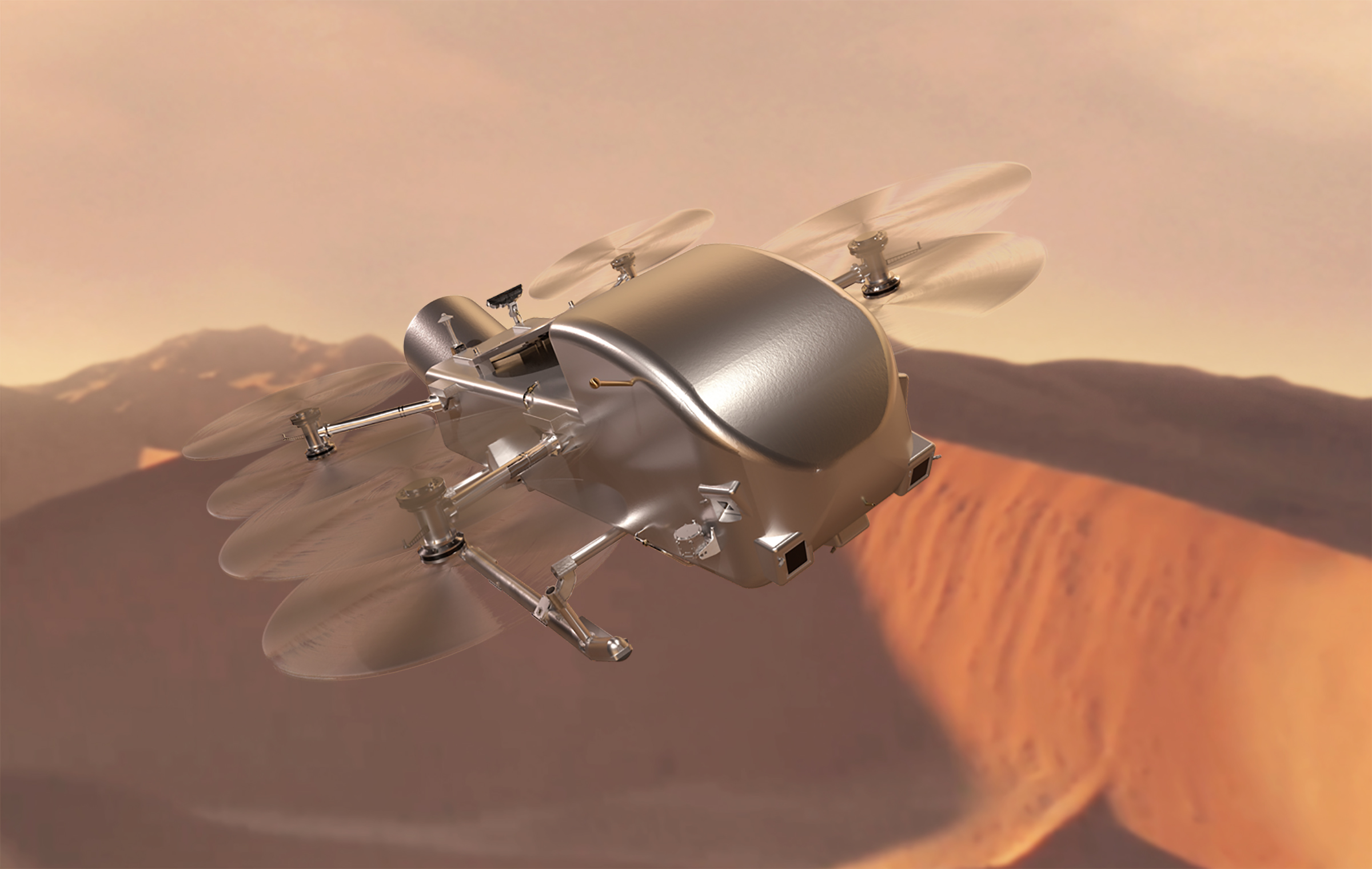
Forecast for Titan: Wild Weather Could Be Ahead
Saturn's moon Titan might be in for some wild weather as it heads into its spring and summer, if two new models are correct. More 
News & Events:
NASA Mars Rover Curiosity Drills Second Rock Target
Curiosity has used the drill on its robotic arm to collect a powdered sample from the interior of a rock called "Cumberland." More 
Women@NASA:
Dr. Nancy Grace Roman
Long before there was a program called Women@NASA, Dr. Nancy Grace Roman was paving the path for women at NASA. More 
Science@NASA:
Bright Explosion on the Moon
NASA researchers who monitor the Moon for meteoroid impacts have detected an explosion ten times brighter than anything they've seen before. More 
News & Events:
Nine-Year-Old Mars Rover Passes 40-Year-Old Record
The Opportunity rover has driven 263 feet, bringing Opportunity's total odometry since landing on Mars to 22.220 statute miles. More 
News & Events:
NASA's Asteroid Sample Return Mission Moves into Development
OSIRIS-REx will rendezvous with the asteroid Bennu in 2018 and return a sample of it to Earth in 2023. More 
News & Events:
Asteroid 1998 QE2 to Sail Past Earth Nine Times Larger Than Cruise Ship
On 31 May 2013, asteroid 1998 QE2 will sail serenely past Earth, getting no closer than about 15 times the distance between Earth and the moon. More 
Science & Technology:
Planets Aligning in the Sunset Sky
Special sunset on 26 May: Venus, Jupiter and Mercury will gather in the fading twilight to form a bright triangle only three degrees wide. More 
 |
|
 |